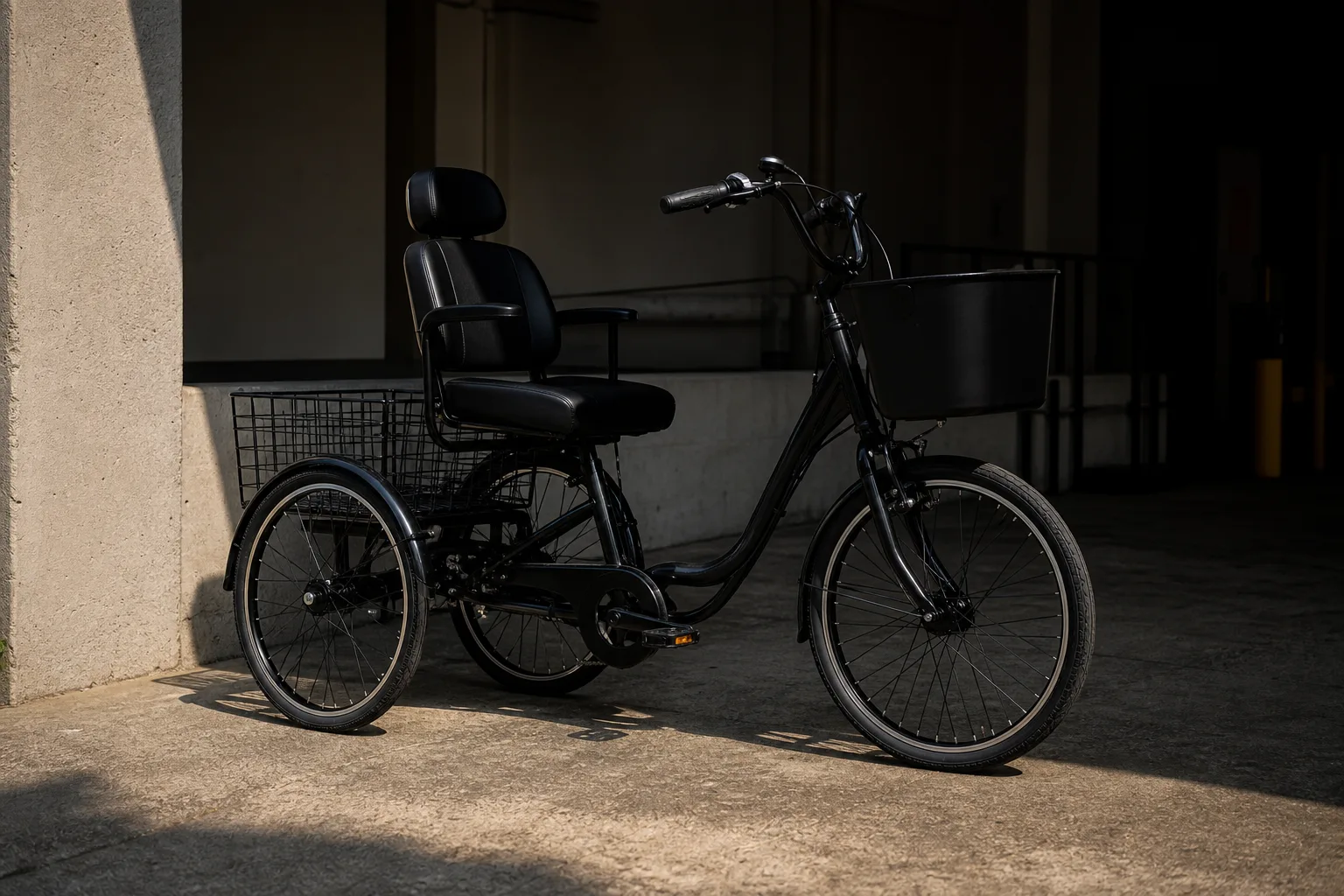
A worked-through account of adult trikes: wheel layouts, motors and batteries, cornering behaviour, storage and the cost of keeping one running. Written once, by one rider, after buying the wrong one first.
The single problem a three-wheeled cycle solves is the one that ends most riding careers: the moment of stopping, when a two-wheeler needs a foot down, a hip shift, and enough ankle strength to hold a forty-pound machine upright at a red light. A trike does not require any of that. It stands there, loaded, on a slope, with groceries in the back, and asks nothing of the rider's balance. That is the whole of the gain, and for a certain rider it is worth every other compromise. The compromises are real, though, and they are mostly geometric rather than mechanical.
The width you did not budget for
A two-wheeler is roughly the width of your handlebars, which is to say roughly the width of your shoulders, and every path, gate, garage door and bike lane in the country was laid out with that assumption embedded in it. A trike is typically somewhere between thirty and thirty-four inches across the rear axle, which is wider than many interior doorways and wider than the gap left by a car parked slightly badly in a shared garage. The consequence people notice first is storage. The consequence that costs more is the daily one: you will re-route your regular rides around bollards, chicanes, narrow bridge approaches and the metal gates that municipalities install specifically to slow cyclists down. None of these are impassable. All of them require you to learn a new map of your own neighborhood.
Weight, and the places it shows up
Three wheels means three tires, three tubes, a rear axle assembly, and usually a frame built heavier because it cannot rely on the rider's body to stabilize it. Add a battery and a hub motor and the numbers climb quickly; many powered models land well north of seventy pounds before you put anything in the basket. On flat pavement with the motor running, that weight is invisible. It reappears the instant the power is gone, when you push the machine up a driveway, lift a wheel over a curb, load it onto a rack rated for two bicycles rather than one heavy trike, or try to turn it around in a hallway. Budget for a ramp, a rack rated well above the actual weight, and the reality that a dead battery three miles out is a phone call rather than a slow ride home.
It corners nothing like the bike you remember
This is the part that surprises people who rode for decades and expect the skill to transfer. A two-wheeler turns by leaning; you countersteer without knowing you do it, and the machine banks into the corner and holds itself there. A trike cannot lean. It turns by steering only, and the rider's mass stays upright and outboard, which means centrifugal force works against you rather than being absorbed by the lean angle. Take a corner at fifteen miles an hour on a trike the way you took it on a bike and the inside rear wheel will come off the ground. New riders should assume the first two weeks are re-learning, on quiet streets, at speeds that feel embarrassingly slow, until the habit of slowing before the turn rather than during it becomes automatic. It does become automatic. It just is not free.
Who is well served, and who is not
The rider who gains most is the one whose balance, not whose legs, is the limiting factor: someone with an inner ear problem, peripheral neuropathy, a hip or knee replacement that makes the foot-down moment genuinely risky, or a history of low-speed falls in parking lots and driveways. For that rider the trade is obvious and lopsided in their favor, and a well-specified electric trike restores a range of independent travel that a two-wheeler had quietly taken away. The rider who is usually better off on a step-through two-wheeler is the one whose actual complaint is the swing leg over a high top tube, or general deconditioning, or nervousness after a long time away from riding. A low step-through frame with a wide saddle and a modest hub motor solves all three, costs less, weighs thirty pounds less, fits through the side gate, and corners the way muscle memory expects.
What the decision actually costs
Price the machine, then price the consequences, because the second number is the one that catches people. Storage that will actually take the width, which for many households means clearing a garage bay or building an outdoor enclosure. A rack or ramp for transport, since most trunk-mounted racks are out of the question. Tires and tubes in threes rather than twos, and a rear axle that a general bike shop may not be equipped to service, so identify a shop willing to work on it before you buy rather than after. Battery replacement somewhere around the five-year mark, at a cost that is a meaningful fraction of the original purchase. The Consumer Product Safety Commission oversees safety standards for bicycles and their electrical systems, which is a useful reason to prefer a manufacturer that documents its battery certification rather than one that does not.
None of that argues against the purchase. It argues for making it with clear eyes, on the strength of what the trike genuinely fixes for you personally, rather than on the assumption that it is a bicycle with one more wheel. It is not. It is a different machine, and the riders who thrive on one are the riders who bought it for the reason it exists.