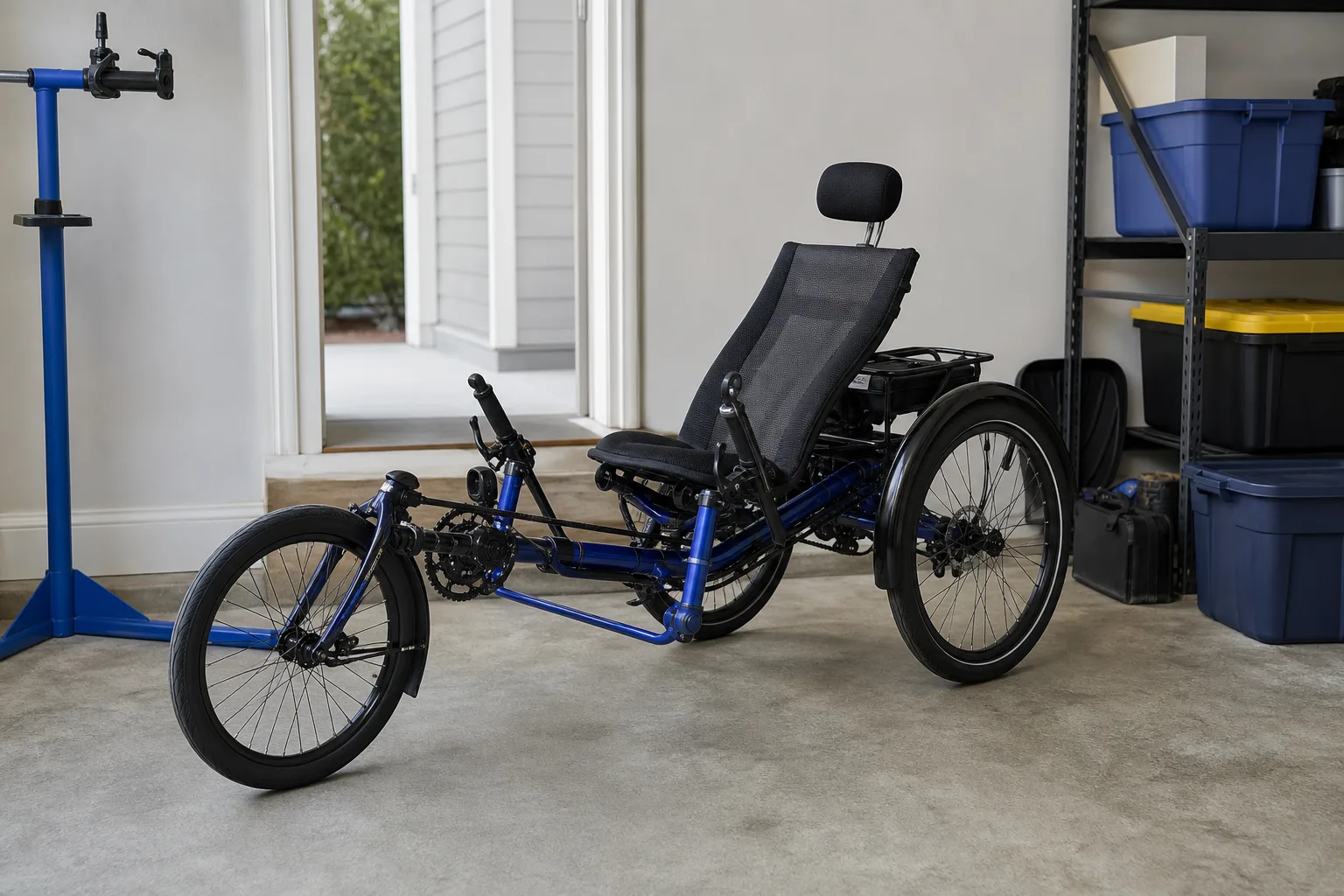
Buying a trike? Check the doorway, the garage, and the repair stand first
Five things a careful buyer measures before ordering an adult trike, from door widths and garage clearance to who in town can actually service it.
Most of the disappointment in adult trike ownership arrives after the machine does, and it arrives as a measurement problem rather than a riding one. A trike that handles beautifully on a rail trail is still, at rest, a rigid rectangle somewhere between thirty and thirty-four inches wide and often six feet long, and that rectangle has to pass through your doors, sit somewhere dry, get into or onto a vehicle, and periodically end up in front of a mechanic. Each of those is checkable with a tape measure before you spend anything.
1. Measure the narrowest point on the route, not the doorway
Buyers measure the garage door and stop there, which is the wrong measurement, because the constraint is almost always further in: a service door to the yard, a gate latch that eats two inches, a basement stair turn, the gap between the water heater and the shelving. Walk the full path the trike will take and record the tightest point, then subtract an inch for hands and knuckles. Published track width is measured tire to tire, so fenders, mirrors, and pannier racks all add to it. Many trikes fold or have a quick-release rear axle that narrows them considerably, and that feature is worth paying for when the route is tight.
2. Plan the parking spot in square feet, not wall space
A two-wheeler leans against a wall or hangs from a hook, and a trike does neither. It occupies roughly fifteen to twenty square feet of floor permanently, and it needs a clear approach so you can push it in straight rather than pivoting it, since pivoting a delta trike in place scrubs the rear tires and is heavy work. Folding models stand on end against a wall and reclaim most of that footprint. If the spot is a garage shared with a car, check the door swing of the car while parked, because that is the clearance people forget until they have creased a fender.
3. Decide early how it travels, because the answer shapes the purchase
Trikes are heavy, commonly fifty to eighty pounds unpowered and considerably more with a battery and mid-drive, and they do not go on a standard two-bike hitch rack. The realistic options are a hitch platform rack rated for the weight and width, a small utility trailer, or a ramp into a van or pickup bed. A folding aluminum ramp with a nonslip surface makes loading a one-person job; a removable battery makes it a lighter one. If the vehicle you already own cannot take the trike, that is a fact worth knowing before the deposit, not after.
4. Find the shop that can lift it before you need one
This is the quiet one. A conventional repair stand clamps a seat tube or a top tube and lifts the bike clear of the floor, and a trike has neither the geometry nor the balance for that, so a shop with only clamp stands will work on your trike bent over the floor or will decline it. Some shops have a platform lift, a low work table, or a shop-built cradle, and those are the ones to call. Ask specifically whether they service recumbents and trikes, whether they can true a twenty-inch rear wheel, and whether they will work on an electric drive system. The Consumer Product Safety Commission oversees safety requirements for bicycles sold in the United States, which covers trikes too, and a shop that treats brake work seriously will already know that.
5. Budget for two front tires, brake pads, and the odd proprietary part
A tadpole trike wears its two front tires unevenly and faster than a bike does, because cornering loads the outside wheel hard and any toe-in misalignment scrubs rubber continuously. Check toe-in annually. Brake pads go quickly on a trike that carries cargo or a rider on hills, since the machine cannot be slowed by shifting weight the way a bicycle is. Most consumables are standard and cheap: tires, tubes, chain, cables, disc pads. The parts that are not standard are the frame-specific ones, idler pulleys, seat hardware, steering linkage, and those come from the manufacturer, so buy from a maker with a working parts department and a US distributor.
A realistic annual figure for a trike ridden regularly is a set of tires, a chain, two or three sets of pads, and one shop visit, plus a battery reserve if the trike is powered. Write those numbers down before you buy, and the ownership stops producing surprises.
Manufacturers quote track width tire to tire, but fenders, mirrors, and rack stays add real inches. Measure the widest fitted point, not the spec sheet number.